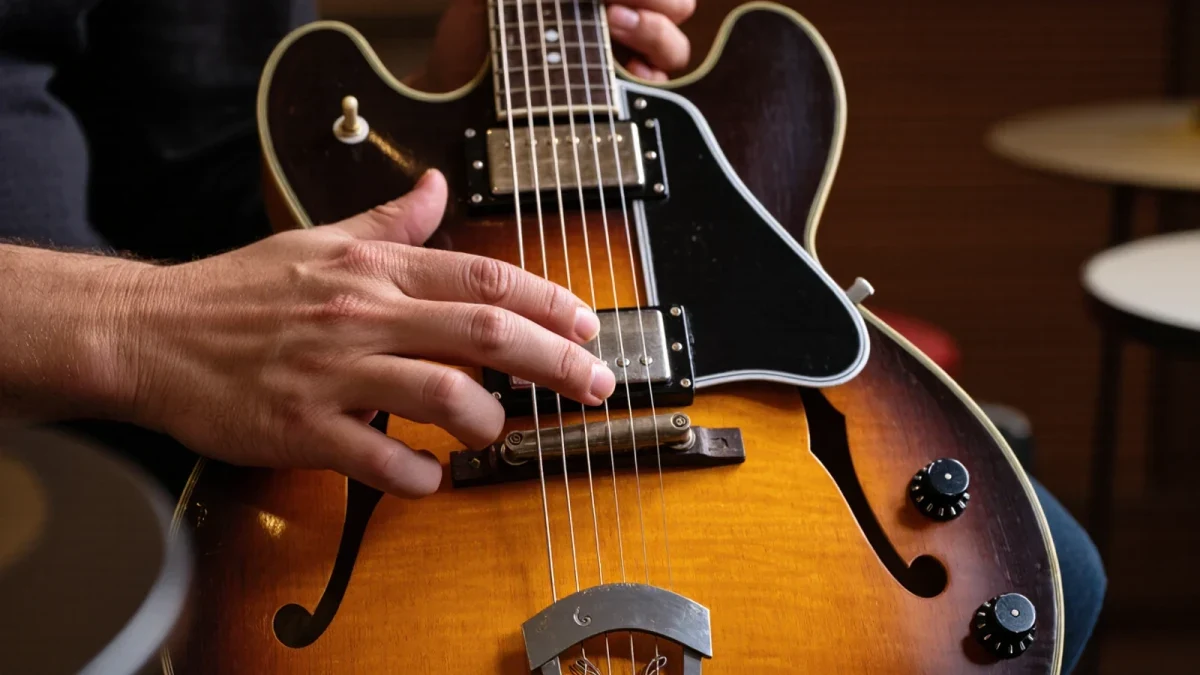
Wes Montgomery is the jazz guitarist whose tone most players can name within two bars: a fat, rounded attack produced without a pick, on a Gibson L-5 archtop, using the side of his right thumb. Born John Leslie Montgomery in Indianapolis on March 6, 1925, he did not start the instrument until around age 19, learned Charlie Christian solos off records, and was dead at 43 — yet Britannica's editors call him probably the most influential postwar jazz improviser on his instrument. That is a documented verdict, not a fan's.
How did a welder become the most copied jazz guitarist alive?
Montgomery taught himself by slowing down Charlie Christian records and learning the solos note for note, an account he gave in interviews published by Down Beat. By 1948 he was good enough to tour with Lionel Hampton's band, a stretch that lasted into 1950. Then came the part that matters to any player balancing work and practice: he returned to Indianapolis, took factory and welding jobs to support a family, and practiced after hours. The late-night hours shaped the technique itself. Playing in a thin-walled house while his family slept, he dropped the pick and used his thumb because it was quieter — a practical compromise that became his signature. His brothers, bassist Monk and pianist-vibraphonist Buddy Montgomery, kept him playing in local groups until Cannonball Adderley heard him in 1959 and carried the word to Riverside Records producer Orrin Keepnews, who signed him.
What gear did Montgomery actually play?
The documented answer is short. His main instrument was a Gibson L-5CES, the 17-inch full-depth archtop with a spruce top, maple back and sides, and twin humbuckers per Gibson's catalog description of the model. He strung it and played it straight into the amplifier, no pedals on record; the octave passages and block chords were all right-hand technique. Players chasing the sound should note what the sources do not establish — no supplied document records his string gauges or exact amp settings, so treat any claimed recipe as folklore rather than fact.
Why do guitarists study the octave technique?
Montgomery built solos in three documented layers: single lines with the thumb, the same lines doubled in octaves, and chord solos where the melody rides on top of moving block chords. The octave passages are the ones that get transcribed first, because they solve a real problem — how to fill out a full-band arrangement with one instrument. Played with the fleshy side of the thumb instead of a pick, the doubled line loses the pick attack and gains a rounded, horn-like sustain. As Montgomery demonstrated across his Riverside recordings, the approach needs no effects chain; it needs accurate intonation across string pairs and a right hand that can keep the doubled notes balanced in volume.
Related stories: Michael Hedges: Two Hands, One Acoustic · Chet Atkins: How One Thumb Built Nashville.
Which records trace the arc?
The Riverside years, starting in 1959, hold the small-group playing guitarists study: Fingerpickin' and the 1960 album The Incredible Jazz Guitar of Wes Montgomery, with the Tommy Flanagan trio, remain the reference points for thumb articulation at tempo. The move to Verve under producer Creed Taylor shifted him toward orchestrated pop material — string sections, Beatles and Bacharach melodies — and it is the 1967 album A Day in the Life that won the Grammy for Best Instrumental Jazz Performance, awarded after his death. Some jazz writers of the day dismissed the Verve years as commercial; the records still sold, and the octaves still cut through the strings. Both things are true at once, and a listener can hold the small-group and orchestral phases side by side without choosing.
What did he leave players who will never play jazz?
Three transferable ideas, all documented in his recorded work. First, economy of motion: the thumb stroke is shorter than a pick stroke, which is how he kept tempo at bebop speed without tension. Second, dynamics as arrangement: the shift from single line to octaves to chords is a volume and texture plan you can borrow for any solo performance. Third, the reminder that a day job and late starts do not disqualify anyone — Montgomery was past 30 before his first recording session as a leader. He died of a heart attack in Indianapolis on June 15, 1968, at 43. Indiana University's Jacobs School of Music has since staged tribute performances marking a century since his birth, a measure of how far the thumb traveled from the welding shop.
Where can you hear the documentation?
The Riverside and Verve catalogs remain in print and streaming. For period context, the BBC's own 1965 studio session with his quartet survives in the corporation's archives and has been transcribed in published form — evidence that British broadcasters treated him as a headline act during his lifetime. Anything beyond the discography — anecdotes about specific nights, quoted advice to students — should be checked against a named source before it is repeated as fact, because the Montgomery story has collected embellishments over six decades.