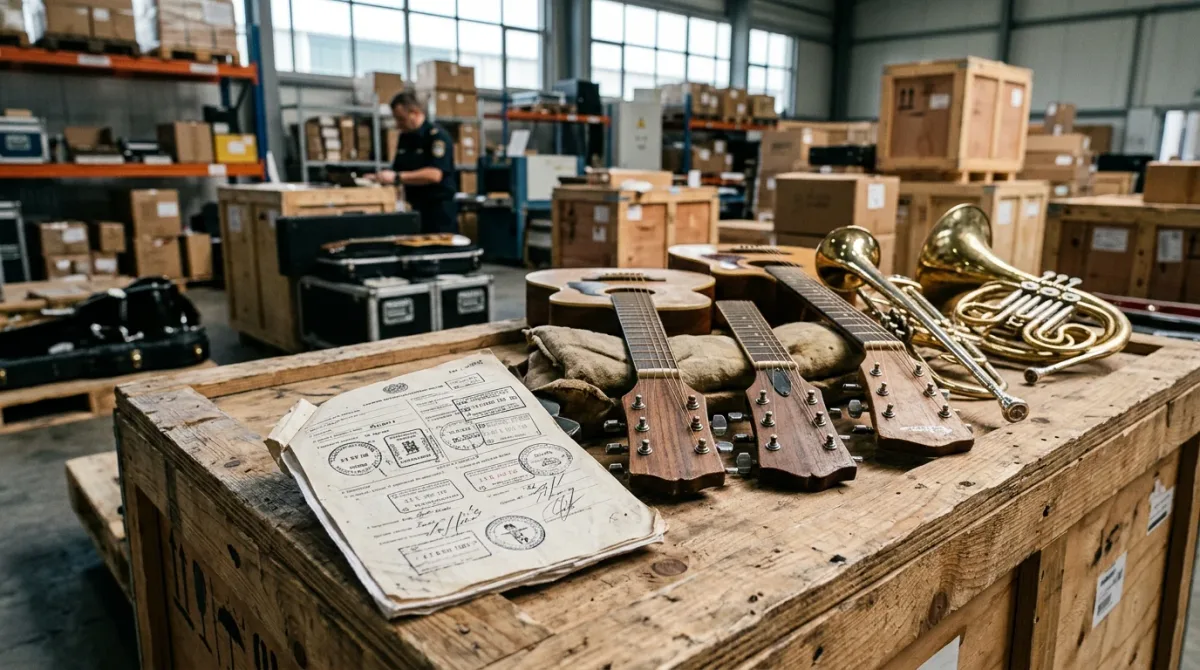
On August 6, 2026, NAMM president and CEO John Mlynczak asked federal regulators to leave brass-wind instruments out of a new round of tariffs on steel, aluminum, and copper products, warning the move would create "empty music rooms" in schools, per NAMM's statement that day. The proposal targets HTSUS codes 9205.10.0040 and 9205.10.0080 — the classification for brass-wind instruments like trumpets and trombones. Guitars aren't on that list.
That distinction matters for anyone shopping for a guitar, because a separate NAMM filing a month earlier aimed at a much broader target: HTS Chapter 92, the tariff schedule chapter that covers guitars, strings, and accessories alongside brass and woodwinds. On July 7, 2026, NAMM asked the U.S. Trade Representative to add HTS Chapter 92 products to the exemption lists in two open proceedings — a reciprocal-tariff review tied to trade talks with China, and a Section 301 forced-labor action — arguing that duties on instrument parts don't address labor conditions and mostly just raise shelf prices, per NAMM's July 7 filing.
The numbers behind the push, also per that filing: American instrument companies paid roughly $1.34 billion in tariffs in 2025, and the industry's average effective tariff rate climbed from 15.9% that year to 16.6% in the first quarter of 2026. NAMM's August 6 statement cites a Peterson Institute study tying earlier tariffs to a 27% drop in wind-instrument imports and a 20.3% drop in piano imports during 2025 — evidence, NAMM argues, that duties show up as fewer instruments reaching store floors, not just higher tags on the ones that do.
What Actually Moves Guitar Prices
Nothing in the brass-wind proposal changes what an electric or acoustic guitar costs today — that fight stays confined to trumpets, trombones, and other instruments classified under HTSUS 9205.10, per NAMM's August 6 statement. Guitars sit under the Section 301 duties NAMM is contesting in its other filing, which it puts at 7.5% to 25% depending on the instrument's country of origin and classification. If the U.S. Trade Representative grants either the China reciprocal-tariff exemption or the forced-labor exemption for HTS Chapter 92, that's the ruling that would actually move sticker prices on imported guitars — not the brass-wind case getting the attention this month.
NAMM frames the fight around the roughly 25 million students it says take part in school music programs each year, a figure repeated across both filings; it also promoted the case in a nationally televised interview on August 12, though its own release announcing that appearance did not detail what was said on air, per NAMM's August 12 release. As of this writing, neither the China reciprocal-tariff list nor the forced-labor exemption request had been ruled on, and the comment period on the brass-wind proposal remained open.
For a related reviews perspective, read How to Choose a Guitar Humidifier: Specs, Prices, Trade-Offs.