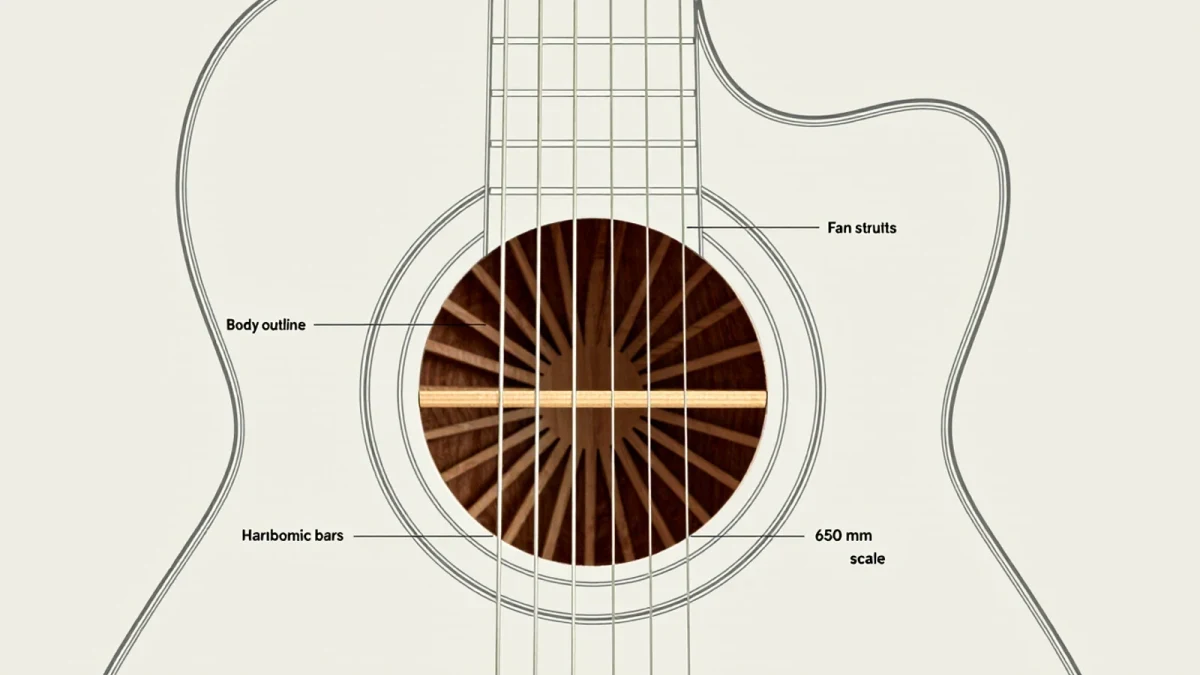
A Torres guitar is an instrument built by the Spanish luthier Antonio de Torres (1817-1892), whose design — a larger body, seven-fan-strut top bracing, and a 650 mm scale — defines the modern classical guitar. Museums and auction houses credit Torres with establishing the form around the 1850s; essentially every concert nylon-string made since, from Cordoba student models to hand-built concert instruments, is a descendant of his pattern. If you play classical guitar, you are playing inside Torres's decisions.
What did guitars look like before Torres?
Early nineteenth-century guitars were smaller, quieter instruments. Romantic-era guitars by makers such as René Lacôte in Paris and Johann Stauffer in Vienna typically had bodies around 30 to 40 percent smaller in air volume than a modern classical, narrower bodies, lighter construction, and bracing that varied maker to maker — often simple lateral bars. They were salon instruments, tuned and strung with gut, suited to small rooms and amateur music-making.
That variability was the problem Torres solved. Before his mature work, there was no consensus on body proportions, string length, or internal architecture. After it, there was — and the consensus held. The Spanish national Museu de la Música in Barcelona and the Museu Gaudí-adjacent collections hold original Torres instruments that document the shift.
What exactly did Torres change?
Three changes carry the weight. First, he enlarged the body and lowered its waist proportions, creating more vibrating air mass and a fuller low end. Second, and most consequential, he standardized fan bracing: seven wooden struts fanned under the bridge area of the top, which let the thin spruce or cedar face move more freely while staying structurally stable. Third, he settled on a longer string scale — around 650 mm — and reinforced the area around the soundhole with the rosette and harmonic bars we still use.
He also tilted the fingerboard's geometry and thickened the top near the edges, details luthiers still debate. The point is not that Torres invented each part; earlier Spanish makers such as José Pagés experimented with fan-style bracing. Torres combined the elements into a repeatable system that other builders copied because it simply worked louder and projected better.
Why does fan bracing matter to a player?
Bracing is the internal skeleton that stops a guitar top from caving in under string tension while letting it vibrate. Fan bracing strikes the balance that defines the classical sound: strong sustain, even response across the strings, and a warm, rounded voice with the fundamental emphasized over metallic overtones. Later systems — lattice bracing, double tops — push volume higher, but the Torres fan remains the reference sound listeners associate with Spanish classical repertoire.
For a buyer, this means the spec sheet tells you less than the bracing pattern. Two guitars with identical woods and scale can sound notably different if one carries traditional fan bracing and the other a modern lattice. Makers including Cordoba, Ramirez descendants, and hundreds of individual luthiers still list fan bracing as the selling point on their traditional lines.
Related stories: Classical or Steel-String: How to Choose · Classical Guitar Bracing: Fan vs Lattice.
Are real Torres guitars valuable today?
Extremely. Torres built an estimated 150 to 300 instruments, and surviving examples are museum and auction pieces rather than working instruments. Auction results for verified Torres guitars have reached into the hundreds of thousands of dollars; the exact figures depend on condition, provenance, and period, and authentication of any individual instrument is a specialist matter. This article does not attempt to value any specific instrument.
Most players meet Torres's work through copies. The plans of his FE-19 and other instruments circulate widely in the lutherie world, and makers openly build Torres-model guitars. A well-documented modern copy built from a published plan delivers the design's geometry at a normal concert-guitar price, typically $2,000 to $10,000 for hand-built examples as of makers' 2025 price lists.
Should a beginner care about any of this?
Yes, briefly: it explains why student classicals all look alike. When you buy a $150 nylon-string, you are buying a simplified Torres pattern — the body outline, fan-braced top, tied bridge, 650 mm scale, and 12-fret neck-to-body joint are all his template, adapted to factory production. Knowing the lineage also gives you vocabulary for upgrades later: a 'traditional fan-braced concert guitar' means the builder is working inside the Torres system on purpose.
What the sources do not establish: no supplied document quantifies how much Torres's own instruments differ in measured output from his contemporaries' — the claim rests on documented historical consensus and surviving instruments, not published acoustic comparisons.
How do you spot Torres influence on a spec sheet?
Read four lines. Scale length near 650 mm: Torres. Neck joining the body at the 12th fret with a flat, 52 mm-class fingerboard: Torres. Tied rather than pinned bridge on a classical: his construction carried forward. Spruce or cedar top listed with fan bracing, over rosewood or cypress back and sides: the direct lineage. Concert catalogs from current Spanish makers read almost as Torres checklists, because buyers for traditional instruments expect every one of those features.
Deviations are informative too. A cutaway body, a radiused narrower neck, or onboard electronics means the maker is blending steel-string conventions into the Torres frame — the crossover category. None of that is worse; it simply documents how far a builder has stepped from the 1850s template, and knowing the baseline turns a spec sheet into a story instead of a list of numbers.