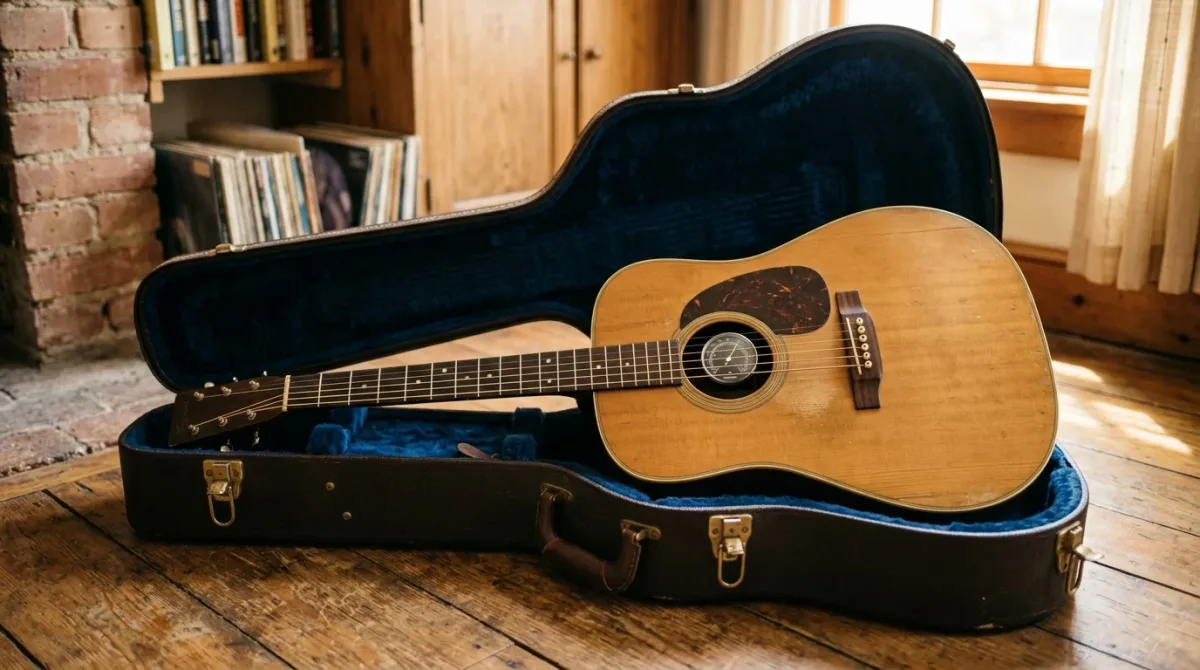
Acoustic guitars are built almost entirely from wood, and wood is hygroscopic: it takes on and gives off moisture until it matches the humidity around it, which is why most acoustic makers target a specific relative-humidity band, generally in the mid-40s to mid-50s percent, to keep an instrument's top, back, and neck stable.
What actually happens inside a guitar when humidity changes?
A guitar's soundboard, back, and sides are thin slices of wood held under tension by string pull and internal bracing, so small shifts in the wood's moisture content show up as movement in the instrument itself. Wood science calls the point where a piece of wood stops gaining or losing moisture the equilibrium moisture content, or EMC. Per the U.S. Forest Service's Forest Products Laboratory, "if wood remains long enough in air where the relative humidity and temperature remain constant, the moisture content will also become constant at a value known as the equilibrium moisture content," and that value "increases with increasing relative humidity and with decreasing temperature," according to the U.S. Forest Service's research on wood moisture content. Translated to a guitar: drier air pulls moisture out of the wood and it shrinks; more humid air adds moisture and the wood swells.
Martin Guitar's own humidification bulletin puts the ideal target at 50 percent relative humidity, calling it "optimum for effective preservation of wooden objects like guitars," while Taylor's guide to guitar humidifiers gives a slightly wider working range of 45 to 55 percent, noting that Taylor builds its instruments in a shop held at 46 percent RH.
Because a guitar's top is thin, braced, and under roughly 150 to 200 pounds of string tension depending on the instrument, that shrinking and swelling shows up fast — as changes to action and fret feel first, and in extreme cases as cracks.
What are the signs of a guitar that's too dry?
Martin's bulletin lays out a staged progression as relative humidity drops, and it's specific enough to use as a checklist. At around 40 percent RH, players may notice sharp fret ends where the fingerboard has begun to shrink away from the frets. Drop to 35 percent and the top itself starts to shrink, with the soundboard surface looking or feeling "rippled or 'dried in.'" At 30 percent, per the bulletin, "a guitar or two may crack" and tops visibly sink; at 25 percent, "more guitars crack" and fret ends need filing more often. None of these thresholds are exact for every instrument — wood age, bracing pattern, and finish all affect how a given guitar responds — but the bulletin's staged numbers are the maker's own documented reference points, not an independent lab measurement.
| Relative humidity | What Martin's bulletin documents |
|---|---|
| ~50% | Cited as the optimum preservation target |
| ~40% | Sharp fret ends as the fingerboard shrinks |
| ~35% | Top shrinkage; soundboard looks or feels "dried in" |
| ~30% | Sunken tops; occasional cracking |
| ~25% | More frequent cracking; heavier fret filing needed |
| 60%+ | Tarnished frets/strings, swelling, high action, loose braces or bridges |
What are the signs of a guitar that's too humid?
Excess moisture causes a different set of problems. Per Martin's bulletin, at 60 percent relative humidity and above, players can expect "tarnished frets and strings, corrosion to nickel, chrome or gold plating material on tuning machines, swelling of the top and other wood components, high action and loose braces and bridges." Taylor's support documentation describes the same broad pattern from the other direction, noting that insufficient moisture causes "bad string action and buzzing, protruding fret ends, wood cracking, top sinking, bridge lifting, and other damage" — the point both makers make is that the guitar's action and playability are usually the first place humidity trouble shows up, well before anything looks visibly wrong.
How do you humidify a guitar properly?
Both makers describe the same basic mechanism: a case humidifier holds moisture near the guitar and releases it slowly, raising the local RH inside a closed case even if the room itself is drier. Taylor's guide walks through two common types. The D'Addario Two-Way system uses "disposable, moisture-filled packets with a breathable membrane" containing only "salt and pure water," designed to hold the air inside a sealed case at 45 to 50 percent RH; those packets last "from two to six months" before they need replacing, per Taylor. The Oasis-style humidifier instead uses "a watertight container with a specially designed fabric for water vapor to pass through," which the player refills with water directly.
Taylor's documentation also flags a placement detail worth repeating: "avoid humidifiers that seal off the soundhole, unless you use a secondary humidifier behind the peghead," since the neck and headstock need moisture exposure too, and a soundhole-only humidifier can leave the neck comparatively dry even while the body stays in range. For dry climates or dry winters indoors, Martin's bulletin recommends a room or case humidifier paired with a hygrometer; for excess humidity, it recommends a dehumidifier or simple air conditioning, which naturally pulls moisture out of the air.
How do you know what the humidity actually is?
Guessing doesn't work reliably, and both makers point to the same tool: a hygrometer, ideally placed inside the case rather than just read off a room thermostat, since a closed case can run drier or more humid than the room around it. Taylor's guide is blunt about it — "using a digital hygrometer to monitor the humidity level inside the case is the only way to be certain" — and Martin's bulletin recommends the same instrument for tracking conditions before symptoms appear. Neither source specifies a particular hygrometer brand or accuracy standard, and neither maker's documentation covers how quickly a guitar recovers once it's been humidified back into range, which is a gap worth noting: these bulletins describe what happens and what to do about it, not a guaranteed recovery timeline.
FAQ
- What's the target humidity range for an acoustic guitar? Martin's bulletin cites 50 percent RH as the optimum preservation target, while Taylor's guide gives a working range of 45 to 55 percent, noting its own guitars are built at 46 percent RH.
- How often do case humidifier packets need replacing? Per Taylor's documentation, D'Addario's two-way humidity packets last roughly two to six months before they need to be swapped out, depending on how much moisture they're absorbing or releasing.
- Should a humidifier cover the soundhole? Taylor's guide advises against sealing off the soundhole with a humidifier unless a second humidifier is also placed near the peghead, since the neck needs moisture exposure independent of the body.
For a related music perspective, read Guitar Humidity Explained: Why 45 to 55 Percent Matters.
For more context, read Truss Rods Explained: The Mechanism Behind Neck Relief.