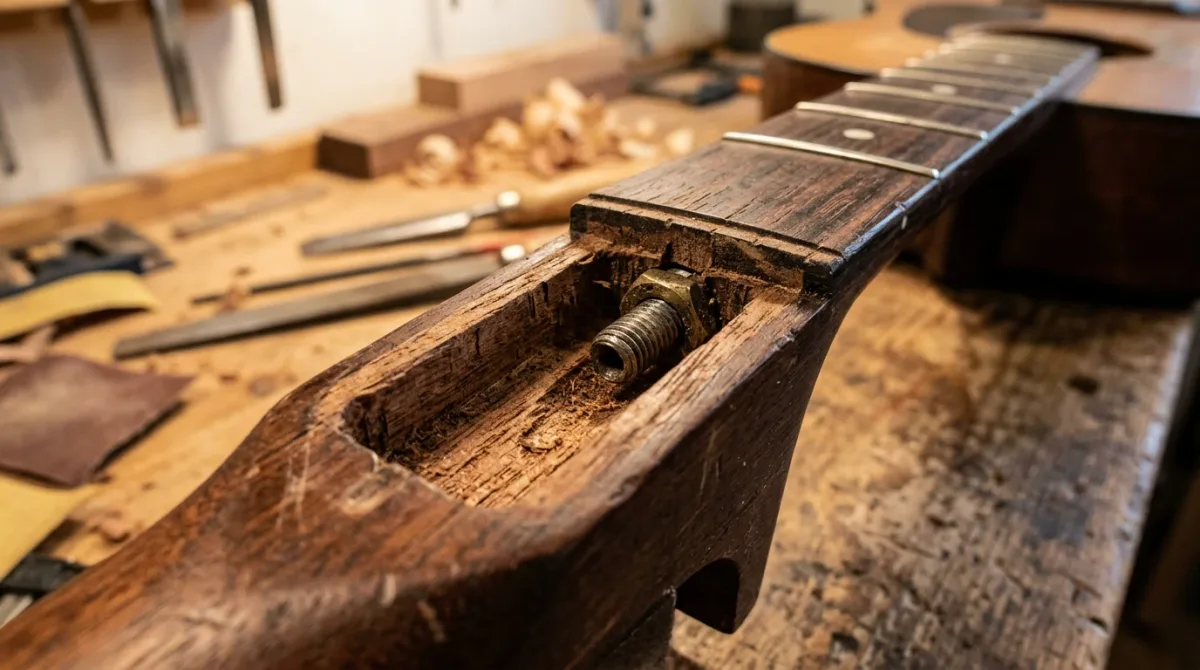
A truss rod is a metal reinforcement bar running the length of a guitar's neck, and it exists to counteract the pull of the strings: a set of light-gauge strings alone puts roughly 200 pounds of tension on the neck, per Fender's own maintenance documentation, and without a rod resisting that force the neck would bow forward over time.
What does a truss rod actually do?
The rod works against string tension rather than with it. Strings pull the neck into a forward, or "up," bow; the truss rod pulls back the other way, and turning it changes how much that counter-force wins, per Fender's documentation and Taylor Guitars' published maintenance guidance. Climate plays a role too — wood expands, contracts, and warps with temperature and humidity shifts, which is part of why the same guitar can need a different setting in July than in January, per Fender's documentation.
The result of that tug-of-war is called "relief": a small amount of forward curve in the neck, not a perfectly straight board. A totally flat neck under tension tends to buzz; a small, even forward bow gives the vibrating string just enough clearance over the frets, per Taylor Guitars' published guidance.
How does tightening or loosening change the neck?
Tightening the rod pulls the neck backward, straightening a forward bow and lowering action; loosening it lets the neck flex forward under string tension, adding relief and raising action, according to Taylor Guitars' documentation. Too little relief — an over-tightened rod — bows the neck backward, drops string height, and increases buzz; too much relief does the opposite, raising string height, per the same source.
StewMac's Dan Erlewine, in the company's published trade-secrets guide, frames the mechanism the same way from the builder's side: "guitar necks bend, especially over the years from string tension," and the rod is set on a curve inside the neck so that tightening it works to straighten the neck against that pull.
What's the difference between single-action and dual-action truss rods?
A single-action rod is anchored at one end and threaded at the other; tightening it pulls the neck straighter, and loosening it simply releases that pull, letting the neck return toward an up-bow position, as StewMac's guide explains. It can correct a forward bow, but it cannot actively push a neck that has bowed backward — that generally means removing the neck or living with the back-bow.
A dual-action rod, sometimes called a double-action or "Hot Rod" design, works in both directions: loosening it doesn't just release tension, it actively forces the neck the other way, per StewMac's documentation. Fender describes an example of this approach on its American Elite line, where a "double action truss rod adjustment wheel" lets a player dial in relief without pulling the neck. Because a dual-action rod can correct both up-bow and back-bow, it's the more forgiving design for a player making adjustments themselves — a single-action rod leaves less margin for error in the wrong direction.
How much relief should a neck have, and how do you check it?
Taylor Guitars' recommended target is a gap "slightly thinner than a business card" between the low E string and the 6th fret, measured with the string fretted at both the 1st and 14th frets at once. That's not a universal spec for every maker and scale length, but it's a documented reference point for what "a bit of forward relief" looks like in practice.
Checking relief doesn't require removing the strings. Both Taylor Guitars and StewMac describe versions of the same basic test:
- Tune the guitar to the tuning you actually play in, since tension — and therefore relief — changes with tuning, per Taylor Guitars' guidance.
- Press a string down simultaneously at the 1st fret and the 14th fret, using the string itself as a straightedge.
- Look at the gap between the bottom of the string and the top of the 6th fret.
- Compare that gap to the target — Taylor's business-card reference, or a feeler gauge if you have one.
StewMac's guide adds that a luthier will typically also sight down the neck with a dedicated straightedge laid across the frets before touching the rod, to see the shape of any bow before deciding which way to turn.
What tools do you need, and which way do you turn?
The truss rod nut is usually reached at the headstock with an Allen wrench or a thin-walled nut driver — Taylor specifies a 1/4-inch thin-walled nut driver for its own necks — though some designs put the access point at the heel end of the neck instead, per Fender's documentation. StewMac's guide also recommends a felt-tip pen to mark the nut's starting position before turning, so a player can track exactly how far they've gone.
Direction follows the same rule on both single- and dual-action rods: clockwise tightens and reduces forward relief, counterclockwise loosens and adds it — "righty-tighty, lefty-loosey," as StewMac's guide puts it. StewMac also notes that a typical correction is small: as little as an eighth to a quarter turn at a time, followed by re-checking relief before turning further.
When should you leave it to a tech?
None of the documentation reviewed here establishes a torque spec or a hard stop for how far a given rod can safely turn before something breaks — that figure varies by maker and rod design, and none of the supplied sources published a universal number. If a rod feels stuck, grinds, or won't move within a small fraction of a turn, that's a signal to stop and see a qualified tech rather than force it, a caution consistent with the small, incremental turns both Taylor Guitars and StewMac recommend.
For a first-time adjustment, the mechanism is simple even when the fix isn't: tighten to fight a forward bow, loosen to fight a backward one, move in small increments, and re-measure relief after every turn. Players chasing buzz or high action after a season of humidity swings are usually chasing the same eighth-inch of relief described in the same maker documentation — the rod just needs a light hand to get there.
For a related music news perspective, read Ben Affleck and Matt Damon Make a Splash on Gossip Stone TV.
For more context, read The Right Humidity for an Acoustic Guitar, Explained.