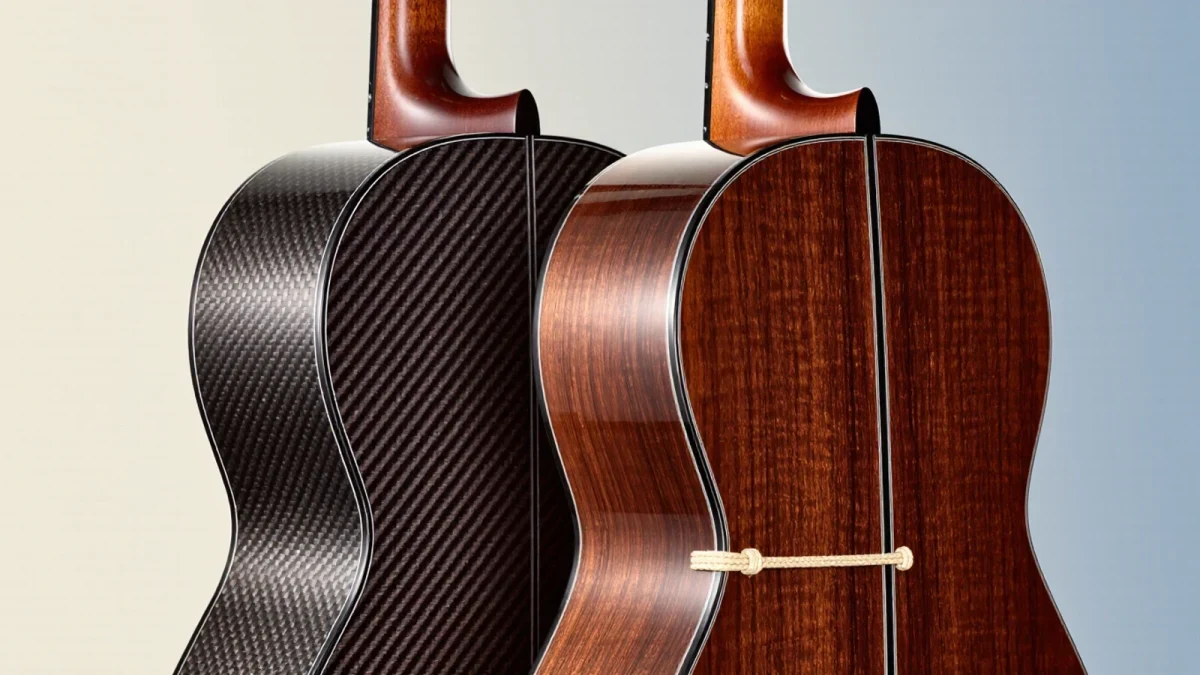
A carbon fiber classical guitar holds its setup through humidity swings that would crack a spruce top, while a traditional wood classical — per the makers of both camps — still carries the tonal complexity most concert players want. Entry carbon fiber classicals from makers such as Emerald and KLOS list from roughly $1,000 to $2,000 as of the makers' May 2026 price pages, with RainSong's classical-line instruments above that; a comparable all-solid wood classical spans the same range. The right call depends less on tone alone than on where you live, where you travel, and how much of your playing happens outdoors or on stages with unstable air.
Strum Magazine publishes sourced guidance, not verdicts from the test bench. Everything below comes from maker documentation and published material data, dated as of May 2026.
What is a carbon fiber guitar actually made of?
Carbon fiber guitars are built from carbon-fiber-reinforced polymer — woven carbon cloth set in resin — molded as a hollow body, sometimes with a foam or honeycomb core in the top. Nothing on the instrument absorbs or releases moisture the way wood does. Makers mold the neck and body as integrated or bonded composite structures, and the fingerboard is typically a composite or engineered wood substitute. There is no seasonal movement: the geometry you receive is the geometry you keep, per Emerald's and RainSong's own product documentation.
Wood classicals, by contrast, are thin plates of spruce or cedar over braced rosewood, maple, or cypress, assembled with glue and dependent on humidity staying in the roughly 40 to 60 percent range — the same window luthiers cite when they specify care instructions.
How do the two compare on stability?
This is composite's whole pitch, and it holds up. Published material properties for carbon-reinforced polymer show negligible moisture absorption versus wood's anisotropic swelling; in practice, a carbon guitar can go from a dry heated apartment to a humid summer stage without top cracks, sharping fret ends, or action drift. Wood instruments in the same conditions need a case humidifier in winter and shade in summer, and a neglected one can need hundreds of dollars of repair.
Wood's stability problem is seasonal, not constant. A instrument that never leaves a climate-controlled room may never show a symptom; the same model carried on a winter airline trip can return with a cracked top or fret ends sharp enough to file fingers. That asymmetry is why the composite question is really a lifestyle question — the material earns its premium in proportion to how often the guitar crosses humidity boundaries, not how well it is built.
Weight and impact resistance also favor composite for travel: makers cite lighter-than-wood builds on some models and far greater tolerance for baggage handling. Wood wins on repairability — any luthier can reglue a brace or cleat a crack, while composite damage generally goes back to the maker.
| Factor | Carbon fiber | Traditional wood |
|---|---|---|
| Humidity tolerance | Essentially immune | Needs 40-60% range |
| Typical entry price | ~$1,000-2,000 as of May 2026 | ~$500-2,000 for all-solid |
| Repairability | Maker-dependent | Any luthier |
| Resale market | Thin | Deep and established |
| Tonal tradition | Modern, even, projecting | The reference concert sound |
Related stories: What Is a Torres Guitar? · How to Build a Classical Practice Routine.
How different do they sound?
Describing tone without test-bench measurements requires attribution, so here it is: composite makers describe their instruments' voice as even, loud, and articulate with strong sustain, and that matches the physics of a stiff molded top. Wood's defenders — and nearly the whole conservatory world — prize what spruce and cedar do as the top ages and the instrument opens up, a claim rooted in playing tradition rather than published measurement. The honest summary is that a fine wood classical offers color and micro-dynamics that composite has not convincingly replicated, while composite offers consistency that wood cannot promise. Whether that trade favors one or the other depends on which failure mode hurts you more: tonal ceiling or environmental risk.
Who should buy which?
Buy composite if your guitar lives a hard life: travel, outdoor gigs, dry winters, humid summers, dorm rooms, boat gigs. Players who tour with a single instrument and cannot babysit humidity are the core carbon constituency, and the makers' customer stories say exactly that. A classical crossover player coming from steel-string or electric stages also adapts quickly to composite's modern voice.
Buy wood if your primary goal is the traditional classical repertoire sound, you can store the instrument sensibly, and you want the deep resale and upgrade market. Conservatory students and traditionalists are wood's constituency. A used all-solid wood classical at $800 often outclasses a new laminate at the same money, and no equivalent used-composite market exists yet at scale.
What about amplification and live work?
Gigging changes the math in composite's favor. Classical guitars are quiet instruments, and most amplified work runs through a pickup or microphone anyway, which compresses the tonal differences players notice acoustically; through a PA, the composite's evenness and feedback resistance — a stiff molded body resists howling at volume — become practical advantages. Several composite makers ship classical models with onboard pickup systems listed as standard on their spec sheets, while wood classicals in the same price tier often leave amplification to the buyer.
Home and studio recording flip the argument back. Microphones capture what the instrument does in the room, and that is where a good wood classical's color survives best. A player who records more than tours might reasonably own wood for the mic and accept the care routine that comes with it.
Which is the better first classical?
On the supplied evidence — maker spec sheets, published material data, and both camps' own positioning — a beginner who practices at home in a stable climate gets more instrument per dollar in wood. A player whose guitar will travel or live in extreme humidity gets more years of trouble-free playing from composite. Neither answer is wrong; the mistake is buying composite for its indestructibility while wanting the wood sound, or buying wood for its sound while living somewhere wood cannot survive unattended.
What the sources did not establish: no supplied published test compares frequency response of composite versus wood classicals under matched conditions, and the aging ('opening up') claim for wood tops rests on player tradition, not controlled study. Demo both if you can — your ears settle what charts cannot.