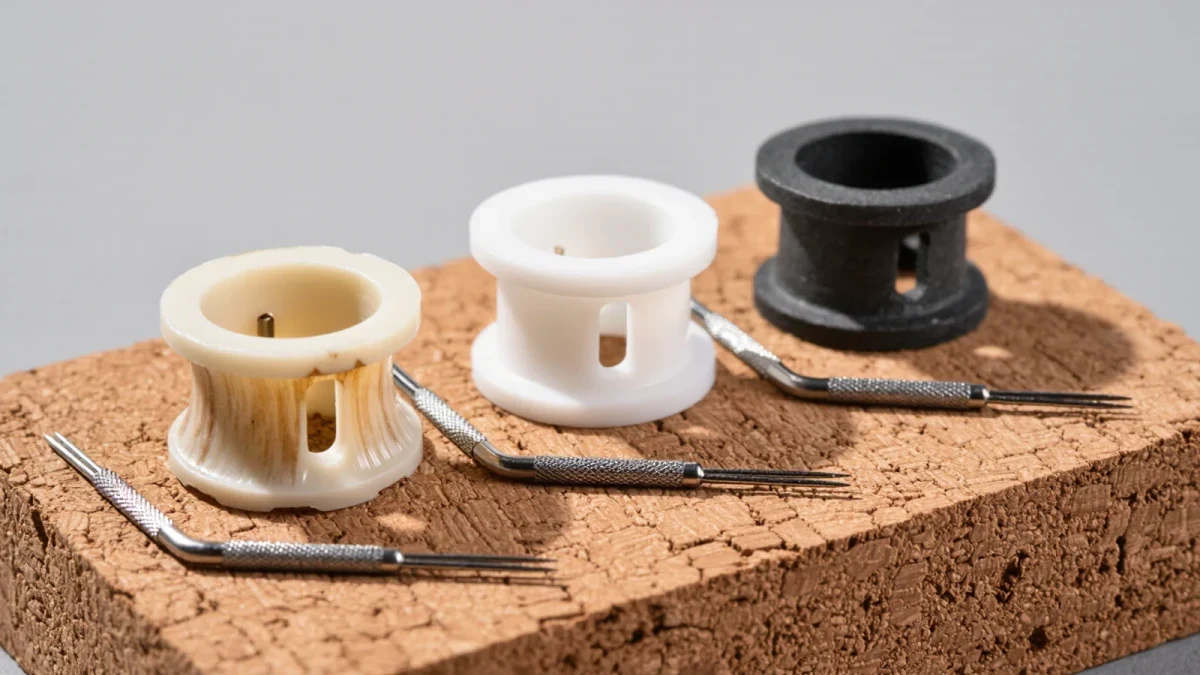
The three leading nut materials for guitars are bone, Tusq, and graphite-loaded synthetics: bone is the traditional hard organic option cut per-instrument by luthiers, Tusq is Graph Tech's branded polycarbonate-based synthetic sold as a consistent pre-formed blank, and Graph Tech's own black TUSQ XL and equivalent graphite-loaded plastics add solid lubricant for tuning stability. A bone nut blank costs roughly $10 to $30 and a synthetic blank $10 to $20, per current luthier-supply listings as of May 2026, with professional installation adding $50 to $100 at typical published shop rates.
This is a sourced explainer. Material properties below come from maker documentation and luthier-supply listings; tone claims are attributed to their makers, and gaps in the evidence are named.
What does the nut actually do?
The nut is the string's endpoint at the headstock: it sets string spacing, defines scale length together with the bridge, and governs how freely each string returns to pitch after a bend or tremolo dip. When a nut slot grabs the string, tuning instability follows — the classic symptom of a string that sticks in its slot and then jumps back into tune a few minutes later. Material matters because of friction and hardness at that contact point; slot geometry matters just as much, per standard setup references. For how the string's endpoints shape what an instrument radiates into the air, the guitar acoustics research collected by the University of New South Wales remains the clearest physics reference a curious player can read without a laboratory.
What do makers say about bone?
Bone is the documented premium tradition: Martin, Taylor, and most boutique builders list bone nuts on their higher-end spec sheets, with Taylor's materials pages describing it as dense and resonant. Hard, well-cut bone wears slowly and, per luthier accounts, files cleanly into precise slots. It is also organic and variable — one blank differs from the next in density and grain, which is why supply listings sell grades of bone blank, from bleached to fossilized ivory substitutes.
The documented downside is consistency, not quality: bone lacks uniformity, and in slots cut slightly tight it can bind, especially on tremolo-equipped guitars. That variability is exactly what synthetics were engineered to remove.
What is Tusq and what does Graph Tech claim for it?
TUSQ is Graph Tech's branded synthetic — the company's own materials describe it as a polycarbonate-based composite engineered to mimic the tonal response of ivory, manufactured with consistent density so every blank behaves like every other. It comes pre-slotted in Fender- and Gibson-compatible dimensions, per the maker's catalog, which makes it a documented drop-in for common guitars. Graph Tech's claims for tone center on consistency: even response string to string, no dead spots from grain variation.
The honest framing: those are maker claims with a real engineering basis (uniform density), but no supplied independent test measures audible differences between a good bone nut and a good Tusq nut on the same guitar.
Related stories: Spruce vs Cedar vs Mahogany Tonewoods · Single-Coil vs Humbucker vs P90 Pickups.
When does a graphite-loaded nut make sense?
Graph Tech's TUSQ XL and competing graphite-loaded plastics embed solid lubricant in the matrix so the slot slides without added fluids. The documented use case is tuning stability under tremolo use and heavy bending — Fender ships lubricated nut formulations on trem-equipped models, per its spec sheets, and the aftermarket graphite nut is a standard documented fix for guitars that return flat after whammy work. It is also the practical answer for players in dry climates who do not want to oil slots seasonally.
The maker-claimed cost is a touch less hardness than premium bone, which in theory wears faster — wear-rate claims across materials are maker and supplier statements, not published measurements.
How do the materials compare on paper?
| Material | Source of truth | Documented strengths | Documented weaknesses |
|---|---|---|---|
| Bone | Luthier tradition; Martin and Taylor spec sheets | Hard, files precisely, premium spec-sheet signal | Variable density; can bind without lubrication |
| TUSQ | Graph Tech documentation | Uniform density; pre-slotted drop-in blanks | Tone advantage over bone is a maker claim |
| TUSQ XL / graphite-loaded | Graph Tech documentation | Self-lubricating; tuning stability under tremolo | Slightly softer per maker claims |
| Plastic (stock) | Entry-level spec sheets | Cheap, consistent to manufacture | Softer; documented first upgrade on budget guitars |
Should you upgrade the nut on a budget guitar?
The nut is one of the two most cost-effective documented upgrades on entry instruments, alongside a setup. Stock plastic nuts on sub-$500 guitars are consistently softer than every option above, per the material lists on maker spec sheets, and a pre-slotted Tusq blank plus installation lands around $70 to $120 total at typical published shop rates as of May 2026. The upgrade buys durability and cleaner slot geometry; whether it buys audible tone is a claim, not a measurement.
What matters more than material?
Slot work. A badly cut bone nut with uneven slots, back-angle problems, or rough walls will tune worse than a perfectly cut plastic one — a point every published setup reference makes before discussing material at all. String trees, tuner quality, and neck relief all sit upstream of nut material in the stability chain. If a guitar tunes poorly, the documented diagnostic order is: setup first, slot geometry second, material third.
What did the sources not establish?
No supplied controlled test isolates nut material's audible effect on tone, and wear-rate comparisons between bone and synthetics rest on supplier statements. Materials, dimensions, prices, and installation rates above are the sourced layer; tone and longevity claims stay labeled as claims. A nut upgrade is worth it for geometry and stability reasons the documentation supports — anyone selling it as a guaranteed tone transformation is quoting marketing, not evidence.