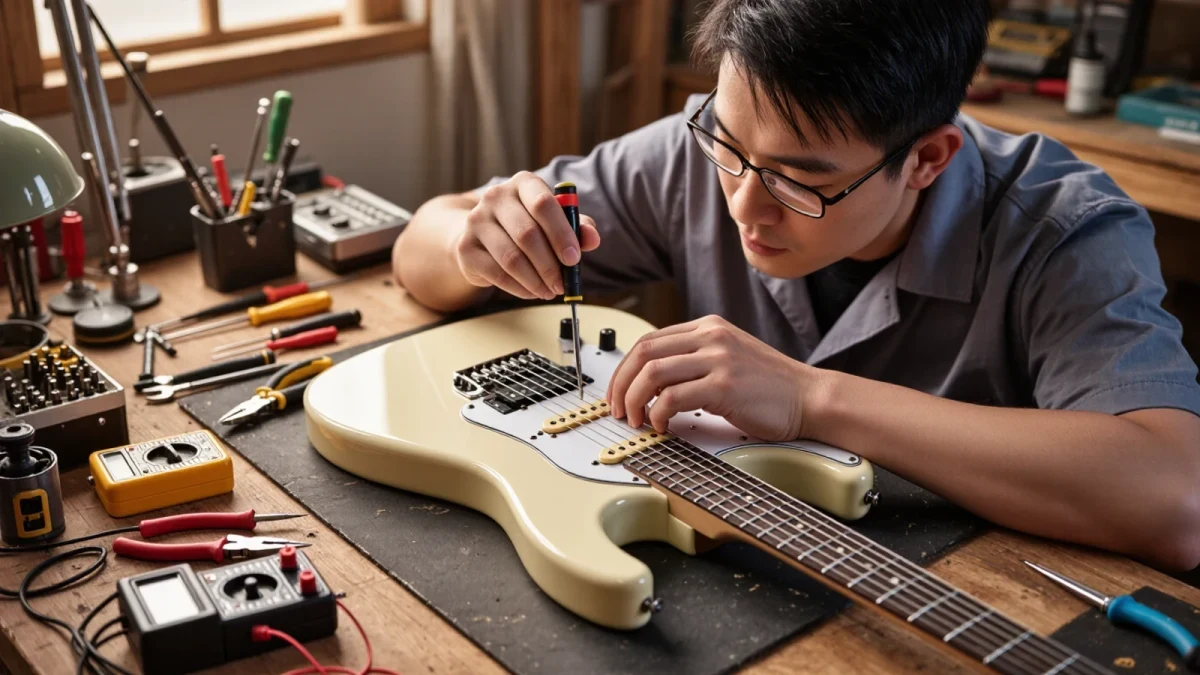
Single-coils, humbuckers, and P90s are the three dominant magnetic pickup designs in electric guitars, and the spec-sheet differences are concrete: a Fender-style single-coil wraps roughly 7,000 to 8,000 turns of fine wire around one magnet-centered bobbin, per maker documentation; a humbucker stacks two coils wired out-of-phase to cancel 60-cycle hum; and a P90 is a single coil with a wider, flatter bobbin and more wire. Output climbs in roughly that order, and hum susceptibility falls — the trade triangle that decides which guitar covers which gig.
Strum Magazine writes sourced explainers, not verdicts from a test bench. Tone descriptions below are maker claims or documented design history, marked as such.
What is a single-coil pickup?
The original design: alnico rod magnets passing directly through one coil, wrapped in thousands of turns of 42 AWG wire. Fender's Stratocaster and Telecaster pickups, per the company's product documentation, remain the archetype. The maker-claimed character is bright, clear, and dynamic — described by Fender's own materials as chiming and articulate, with strong presence in the upper mids.
The documented cost is hum. A single coil acts as an antenna for electromagnetic interference, so under fluorescent lights or near dimmer circuits it picks up 60-cycle hum along with the strings. That limitation is not opinion; it is the reason the humbucker exists.
What is a humbucker and why is it called that?
Seth Lover's 1955 patent for Gibson — documented in the patent record itself — combined two coils with reversed magnetic and electrical polarity so that the hum each coil picks up cancels while the string signal adds. "Humbucking" literally means bucking the hum. With more total wire, output runs higher than most single-coils, and the maker-claimed character is thicker, warmer, with rolled-off top end — Gibson's own descriptions of the Les Paul's burst buckers lean on words like full and rich.
The claimed trade-off is clarity at the extremes: less sparkle on top, less openness than a single-coil at low gain, per the makers' own comparison language. High-gain players get the benefit: hotter output drives an amplifier into distortion earlier, which is why rock and metal solidbodies overwhelmingly ship with humbuckers, per current spec sheets across maker catalogs.
What is a P90?
The P90 predates the humbucker — introduced by Gibson in 1946, per the company's historical documentation. Structurally it is a single coil, but with a wider, flatter coil area and two bar magnets below the bobbin rather than rods through it. That geometry yields more output than a Fender-style single-coil — DC resistance figures on current maker spec sheets typically land in the 8-to-9-kohm range versus roughly 5.5 to 6.5 for vintage-style single-coils.
The maker-claimed character sits between the other two: grittier and midrange-forward like a halfway house, described by makers as raw and snarling. It still hums, being a single coil — P90s are for players who want that midrange grind and accept the noise, a trade documented in every maker's own FAQ language about the design.
Related stories: How to Choose a Travel Guitar · Spruce vs Cedar vs Mahogany Tonewoods.
How do the three compare on paper?
| Design | Coils | Typical output, per spec sheets | Hum | Maker-claimed character |
|---|---|---|---|---|
| Single-coil | One | ~5.5-6.5 kohm DC | Yes | Bright, articulate, dynamic |
| P90 | One, wide bobbin | ~8-9 kohm DC | Yes | Midrange-forward, gritty |
| Humbucker | Two, out-of-phase | ~7.5-16 kohm DC | No | Thick, warm, high-output capable |
DC resistance is a rough proxy, not a tone measurement — makers publish it as a comparative convenience, and two pickups with identical readings can sound nothing alike. Every figure above is from current manufacturer spec sheets.
Which pickup type fits which playing?
On the documented design strengths and maker positioning:
- Country, funk, surf, indie clean — single-coils; the clarity and dynamics are why Fender's designs anchor those genres, per the makers' own artist positioning.
- Blues-rock, punk, garage — P90s; the midrange bite that made them the pickup of early rock-and-roll and British-invasion documentation.
- Rock, metal, high-gain anything — humbuckers; hum cancellation plus output, the engineering answer to loud amplification.
The pickup's place in the electric guitar's whole story — how amplified instruments reshaped popular music — is covered in the BBC's documentary program on the electric guitar's conquest of popular music, which traces the design lineage these three pickup types share.
Can you change pickups later?
Yes, and it is one of the most common modifications. A professional swap runs roughly $50 to $100 per pickup in labor at typical published shop rates as of late 2025, plus the pickups themselves — from about $60 for budget models to over $300 for boutique winds, per current maker list prices. Check two things first, per the routing documentation: the body's routing (a swimming-pool route accepts anything; a tight single-coil route will not take a humbucker without woodwork) and the control cavity's space for different pot values, which humbuckers conventionally use at 500k versus single-coils' 250k.
What did the sources not establish?
No supplied controlled listening test compares the three designs on tone alone. Output figures and hum behavior are measurable and documented; every adjective about warmth, bite, or sparkle is a maker's claim. Ears on a specific guitar, through a specific amp, remain the only instrument that can finish this comparison — and that step belongs to the player, not to this page.