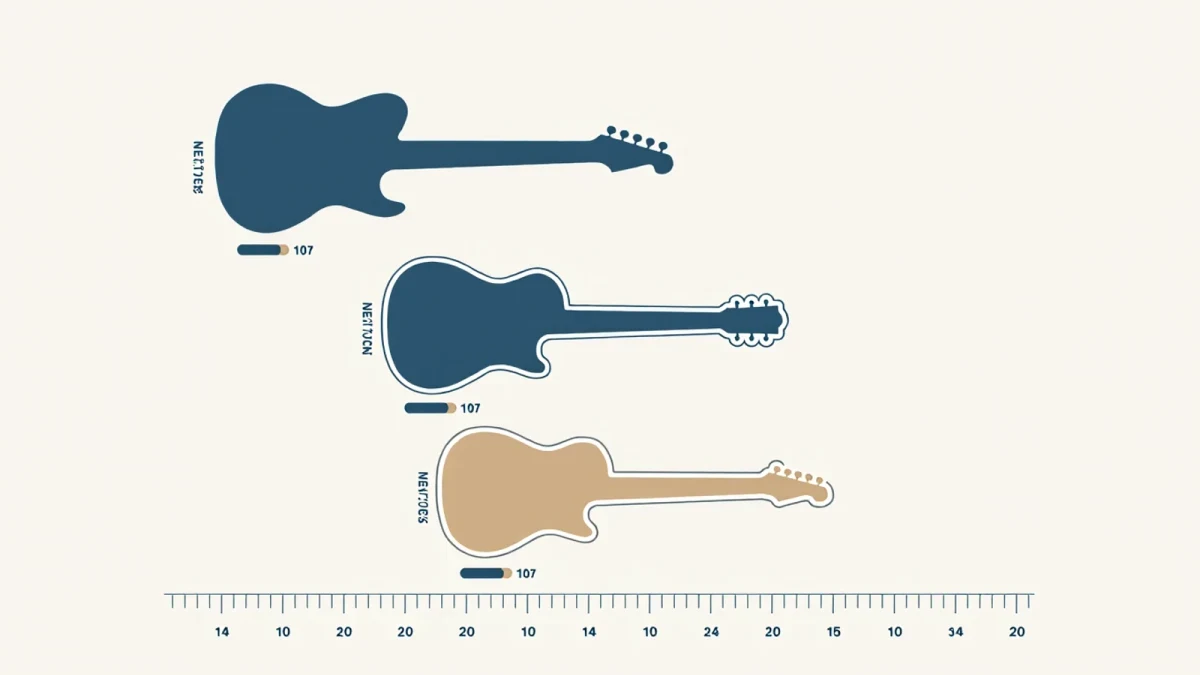
On the supplied evidence — maker spec sheets and published product documentation — the practical pick for most traveling players is a compact full-scale acoustic such as the Martin Steel String Backpacker or Taylor GS Mini format: a 23.5-to-24.9-inch scale in a body that fits airline overhead bins, listed from roughly $199 to $599 as of April 2026, per the makers' and major retailers' current listings. The qualification: players whose travel is mostly trains and cars can carry a full-size instrument and skip the category entirely, while frequent flyers should weigh headless and collapsible designs more seriously.
This is a sourced guide, not a test. Every spec below comes from the maker's documentation, every price is dated to its source's listing, and no hands-on impressions appear anywhere in it. Where the sources are silent, that silence is reported.
What counts as a travel guitar?
The category covers three documented formats. Compact acoustics shrink the body while keeping a playable scale — the Taylor GS Mini, per Taylor's spec sheet, pairs a 23.5-inch scale with a Grand Symphony-derived body about 15 percent shorter than full size. Headless travelers, like the Traveler Guitar line, drop the headstock to cut total length further; per the maker's spec sheets, the Traveler Guitar Ultra-Light runs under 28 inches end to end. Collapsible designs — the Voyage-Air line being the documented pioneer — hinge the neck to fold into a backpack case, unfolding to full scale.
A fourth approach sits outside the category: short-scale compact electrics like the Fender Player Mustang, which at a 24-inch scale and small body travels well without being sold as a traveler. Worth knowing, rarely the answer for strict packing limits.
Which compact acoustic fits which budget?
The acoustic tier, per maker documentation and current listed prices:
- Under $250 — the Martin Steel String Backpacker, listed at $239 as of the maker's spring 2026 listings, per Martin's product page: an extreme body cut, 24-inch scale, all-solid mahogany build the maker describes as uniquely voiced. The documented trade is comfort — the narrow body sits differently against the torso.
- $400-650 — the Taylor GS Mini, listed from $599 as of Taylor's current pricing, per the maker's site: 23.5-inch scale, solid spruce or mahogany top, the format that arguably created the modern compact-acoustic segment.
- Alternative value — Washburn's Traveler series and similar sub-$300 compact acoustics, per current retailer listings, deliver laminate builds at roughly half the GS Mini's price. Per the makers' own material lists, the delta is laminate back and sides and less refined hardware.
When does a headless electric traveler make more sense?
When your constraint is length, not sound. A headless design removes the headstock — roughly 4 to 6 inches of total length, per published dimension comparisons — which is the difference between fitting a luggage diagonal and not. Traveler Guitar's documented lineup carries full 25.5-inch scales in overall lengths conventional guitars cannot approach, with the maker's own materials emphasizing that full-scale feel is preserved because the fret spacing does not change.
The trade-offs are documented too: these instruments lean on headphones or modeling for their sound, since the small body produces little acoustic tone, and their ergonomics assume a strap or a lap desk. Budget roughly $299 to $599 per current listings across the category's main makers.
Related stories: Parlor Guitars: History and Who They Suit · Single-Coil vs Humbucker vs P90 Pickups.
Do folding-neck guitars actually work?
The Voyage-Air design, documented across the maker's product pages and published demonstrations since the late 2000s, hinges at the neck joint and folds into a backpack-style case; the maker claims retuning after unfolding is minor, in the range of a small pitch adjustment rather than a full restring. No independent published test supplied for this guide verifies long-term folding-neck intonation stability — the maker's claim, honestly labeled.
The appeal is packing a full-size dreadnought experience into carry-on dimensions. The cost, per current listings, runs higher than fixed compact acoustics at comparable build levels, which is the price of the hinge mechanism.
How do the formats compare on the numbers?
| Format | Typical scale, per spec sheets | Packed character | Listed price band, April 2026 |
|---|---|---|---|
| Compact acoustic (Backpacker, GS Mini) | 23.5-24 in | Overhead-bin body, playable unplugged | $239-599 |
| Headless electric traveler | Full 25.5 in | Shortest overall length; needs an amp or phones | $299-599 |
| Folding-neck acoustic | Full 25.5 in | Full-size guitar, carry-on when folded | $499+ plus premium |
Prices are as-of dated figures from maker and major-retailer listings in April 2026 and will not hold; verify at purchase. The guitar's portability has always shaped how players write and carry songs between places — a social history traced from flamenco to the blues in the BBC's documentary series on the guitar story.
What should you check before buying?
Four documented checks. First, scale length: 23.5 inches and up feels close to a full-size acoustic; much shorter changes fret spacing noticeably. Second, case quality — the category's whole point is surviving baggage handling, and the makers' included cases range from gig-bag-thin to padded backpack rigs, per the included-accessories lines on each spec sheet. Third, weight: spec sheets list finished weights from under 3 pounds (Backpacker) to 5-plus pounds (folding full-size), which matters on foot. Fourth, your actual packing constraint — airline overhead limits, train racks, or a car trunk set different thresholds.
Two second-tier checks earn their minute. String choice matters more on short scales: the same gauge at 23.5 inches sits at lower tension than at 25.5, so many players document moving up a gauge for comparable feel — a physical consequence of scale length, not taste. And humidification still applies: solid-top travelers crossing climate zones in winter benefit from the same in-case humidity discipline as any solid-wood instrument, per the makers' care documentation, which the smaller body does not waive.
What did the sources not establish?
No supplied source compares the tone of compact travelers against full-size instruments under controlled conditions, and none measures folding-hinge intonation drift over time. Durability-in-transit claims rest on maker marketing and user-document accounts, not published testing. The specs, dimensions, and prices above are the verified layer; tone and durability remain the buyer's own checks.
Segmented recommendation: frequent flyers tight on space — headless electric or folding acoustic, per the length math. Players who want an unplugged songwriting tool that still flies — a GS Mini or Backpacker format, per the spec sheets. And anyone whose travel is mostly by car — a full-size guitar and a good case, the option no travel-specific design beats on sound.