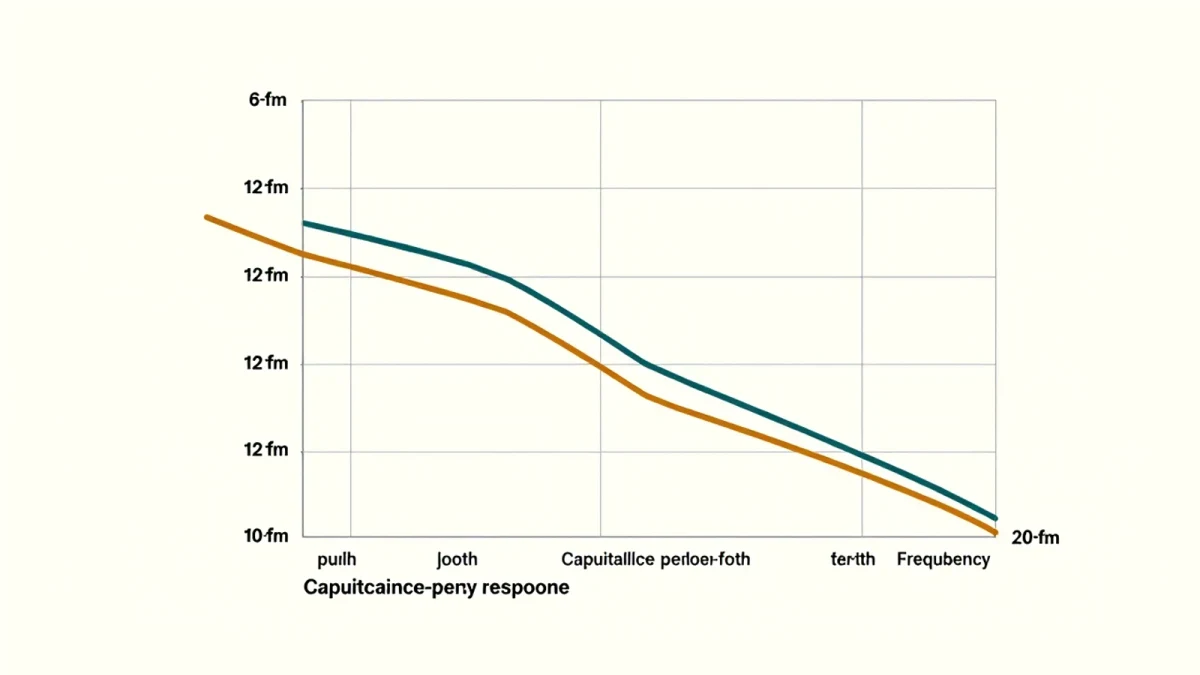
Guitar cable signal loss is caused by capacitance: every instrument cable stores a small charge between its center conductor and its shield, and that capacitance interacts with your pickup's inductance to form a low-pass filter that rolls off high frequencies. The numbers are concrete — typical instrument cables measure roughly 20 to 50 picofarads per foot, per published cable specifications, so a 20-foot run can add 400 to 1,000 pF of capacitance and audibly dull a bright single-coil. Shorter cable and lower capacitance per foot equal more treble at the amp.
This explainer rests on published cable specifications and basic electronics; tone descriptions are framed as measurable filter behavior, and claims from cable marketing are labeled as claims.
What is cable capacitance doing to your tone?
A passive guitar pickup is an inductor, and an inductor plus a capacitor forms a resonant filter. Add capacitance — a longer cable — and the filter's corner frequency drops: highs above it fade first. This is the same physics behind the tone knob on your guitar, which is a variable capacitor wired to do exactly this on purpose. The effect is strongest with high-inductance pickups and long runs; it is negligible with active electronics, because a buffered signal has the current to drive the cable without the filter forming at audible frequencies, per standard electronics references. guitars coverage.
How much treble do you actually lose?
Published cable specs give the raw material. Two documented reference points from maker data sheets: budget cables commonly run around 40 to 50 pF/ft, while low-capacitance designs from makers like Klotz, Mogami, and Evidence Audio publish figures from roughly 15 to 30 pF/ft. Multiply by length and compare: at 18 feet, that is a spread of roughly 270 pF versus 900 pF — enough to move a single-coil's resonant peak well into the audible difference range, per the filter math published in cable makers' technical notes. Whether that difference reads as "lost sparkle" or "finally warm enough" depends on the guitar and the player, which is taste, not measurement.
Does cable length matter more than cable brand?
Length usually dominates. Cutting a 20-foot run to 10 feet halves the capacitance no matter whose logo is on the jacket, a point independent of any marketing. The documented hierarchy for preserving treble in a passive signal chain: shortest workable cable first, low-pF/ft cable second, a buffer or active electronics third. None of this says expensive cables are worthless — the published capacitance figures genuinely differ — but the biggest single lever costs nothing: coil less cable on the floor.
Related stories: Nut Materials: Bone vs Tusq vs Graph Tech · Pin vs Pinless: Acoustic Guitar Bridges.
What else degrades a guitar signal besides capacitance?
- Shielding quality — braided or dense spiral shields reject hum and radio interference better than loose foil wraps, per published cable construction specs; poor shielding manifests as buzz, not tone loss.
- Cable failures — the documented killer of reliability is the solder joint at the plug, which microphonics and intermittent cracks trace to; repairable ends beat molded ones at the bench, per repair references.
- Every true-bypass pedal in series — long chains of true-bypass pedals add effective cable length between the guitar and the first buffered stage, an effect pedal documentation discusses when recommending buffer placement.
Do you need a buffer?
A buffer converts the guitar's high-impedance output to a low-impedance one that drives long cables without the treble-robbing filter. The documented rule from pedal and cable makers alike: if your total cable-plus-effects path runs past roughly 18 to 25 feet of equivalent passive cable, put a buffer early — a Boss-style pedal with buffered bypass, a dedicated buffer unit from roughly $30 to $60 per current listings, or the buffer built into many tuners and acoustic preamps. If you play a 10-foot cable straight into an amp, a buffer buys you nothing measurable.
One nuance from pedal documentation: buffers and true bypass interact. A buffered pedal anywhere in the chain protects everything after it, but the stretch of cable between your guitar and that first buffered stage still counts as passive length. That is why the documented placement advice puts the first buffer early — a tuner with buffered output in position one covers the whole board — and why some players of vintage-style fuzzes, which are documented to react to source impedance, deliberately keep the first run short and the fuzz first instead.
How should you choose a cable on the specs?
| Spec | Documented good range, per maker data sheets | What it buys |
|---|---|---|
| Capacitance | Under ~30 pF/ft | More treble on long runs |
| Shielding | Braided or dense spiral | Hum and RFI rejection |
| Connectors | Repairable metal plugs | Field serviceability |
| Length | Shortest workable | The single biggest treble lever |
The cable is the first stretch of wire your signal travels after the pickup — a link in the chain whose electrified history began with players simply needing to get from one side of a stage to the other. The spec sheet, not the price tag, tells you what it does.
What did the sources not establish?
No supplied controlled listening test compares cable brands on anything but capacitance-driven frequency response, and no supplied evidence supports marketing claims about cable directionality or exotic conductor materials. The measurable layer is capacitance, shielding, and connector durability — everything a published spec sheet states. Everything else is marketing, and paying for it is a choice, not a requirement.